Caring for Elderly Parents from a Distance | How to Know They're Okay
Some images are AI generated
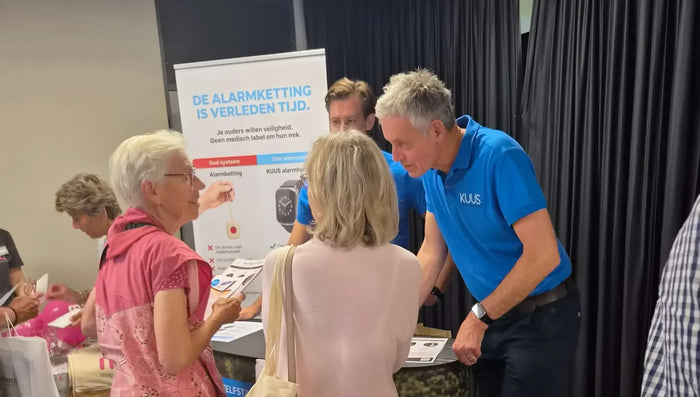
A bit of background. We are Eric and Bas, father and son. We started KUUS. after Eric's mother-in-law lay on the kitchen floor for two days. Her phone was on the worktop and she couldn't reach it. So we know from our own family where the fear behind caring for elderly parents from a distance comes from.
What is caring for elderly parents from a distance?
You live in Manchester, your mother lives in Edinburgh. Or you live abroad and your father still lives in the UK. You call often, you visit at weekends, but you can't do the everyday things yourself. That's caring for elderly parents from a distance: staying involved and organising things without being physically nearby.
It differs from ordinary family care in one respect. You miss the small signals. You don't see that the post is piling up, that the fridge is empty, that your mother has become unsteady on her feet. You need another way to pick up on those signals.
Many people feel guilty about it. You don't need to. Distance doesn't make you a bad son or daughter. It just calls for a bit more organising and a bit less relying on chance.
The biggest worry: a fall nobody notices
Ask ten family carers who live far away what keeps them up at night, and nine will say the same thing. Not the shopping. Not the admin. The fall.
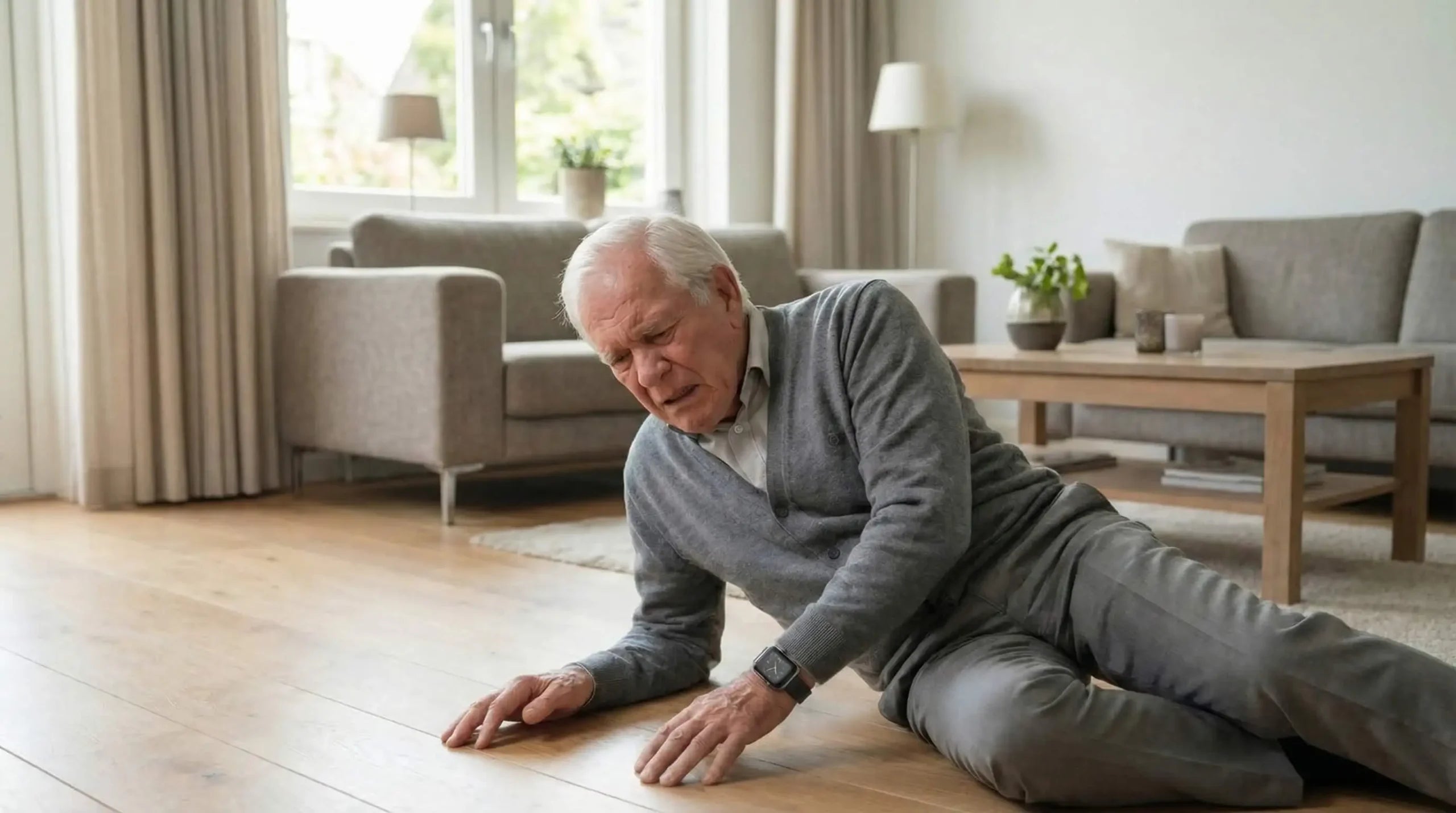
A parent who lives alone and falls often can't reach the phone. Sometimes because of the fall itself, sometimes out of panic, sometimes because they briefly lose consciousness. And if you're hundreds of miles away, a lot of time can pass before anyone notices.
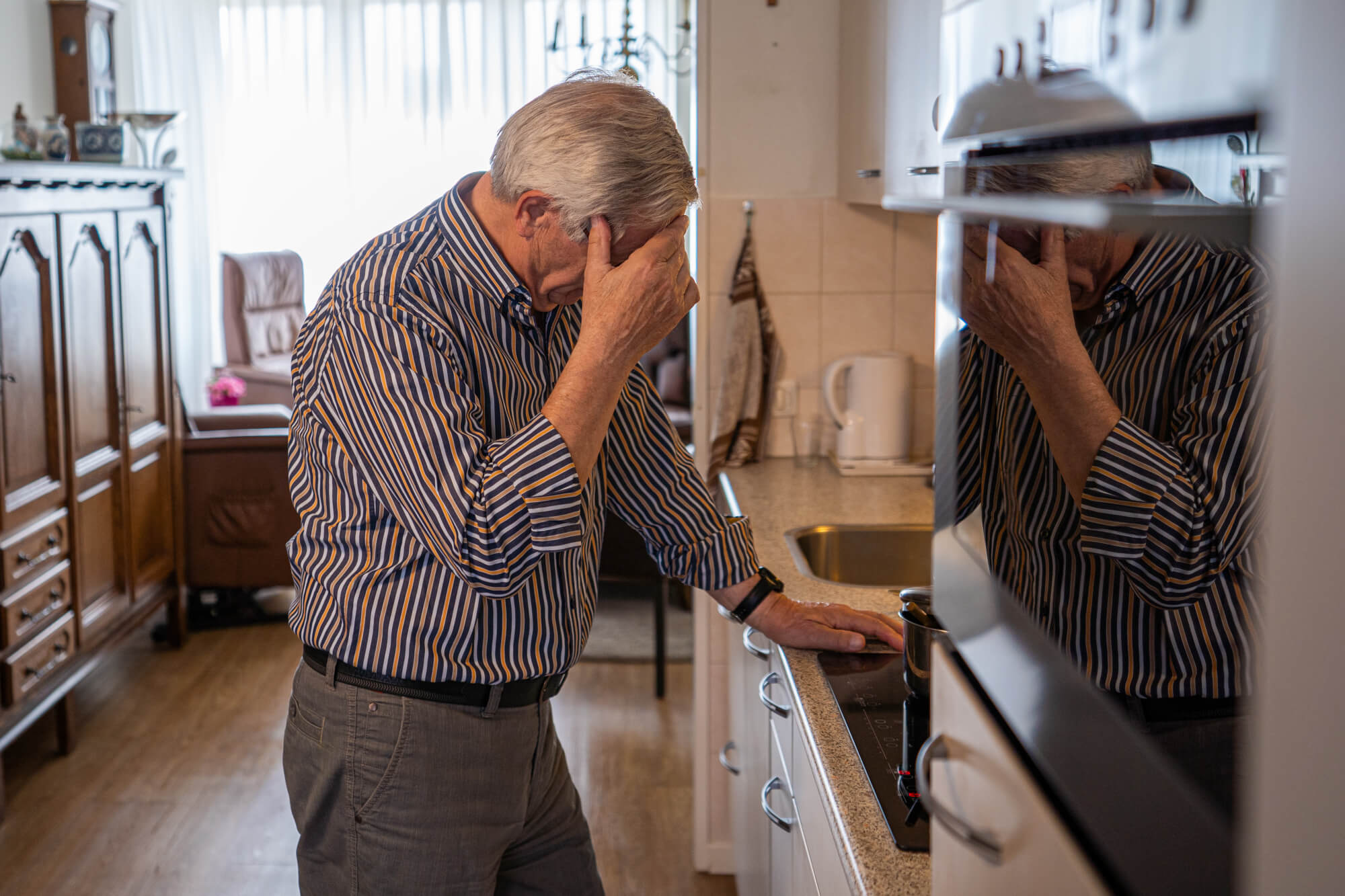
That's why caring for elderly parents from a distance starts with this question: how will I know if something happens, and how quickly can help get there? Everything else matters, but this is the core of it.
Practical ways to stay involved from a distance
A few things that make the biggest difference in practice.
Fixed call times
Not "I'll call sometime", but a set rhythm. Every evening at seven, or every morning after breakfast. The benefit isn't just the contact itself. If the phone isn't answered at the usual time, you know straight away that something might be wrong.
A neighbour or acquaintance nearby
Having one person close by who has a key, and who you can call when you're worried, is worth a great deal. Make that arrangement before you need it, not after. A bottle of wine or a visit to get acquainted is a small effort for a real sense of security.
Sorting out shopping and admin
You can do a lot from a distance. Have groceries delivered online, handle banking together through online banking, receive post digitally. That saves you travel time and saves your parent the hassle.
Contact with the GP or home care service
Make sure you know who the GP is and whether a home care service visits. Ask if you can be listed as a contact person. Local carer support organisations can give you an overview of what support is available.
Tools for caring for elderly parents from a distance
Technology doesn't solve everything, but the right tools take away a lot of worry. A few commonly used ones.
- Video calling. A tablet or phone that lets you see each other. You pick up more from a voice than you'd think, and you can see whether someone looks well.
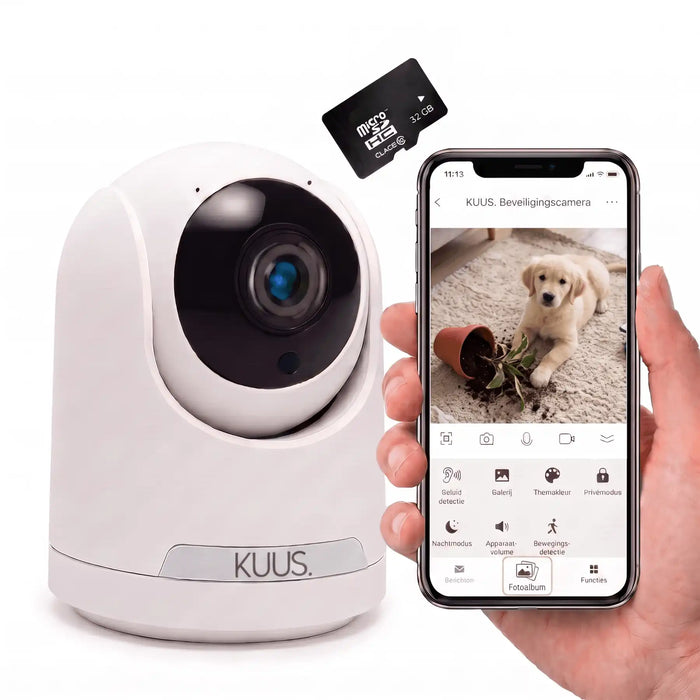
- Smart doorbell or camera. Some families find it reassuring to see whether someone has visited, or whether the post is still on the mat. For others it feels too much like surveillance. Talk it through.
- A personal alarm for elderly parents with an SOS button and fall detection. The tool that directly addresses the biggest worry: the fall nobody notices. More on that below.
- A medication dispenser. If remembering medication becomes a problem, a dispenser gives a timely reminder.
Carer support organisations offer a broader overview of apps and tools, regardless of brand.
What a personal alarm can and can't help with
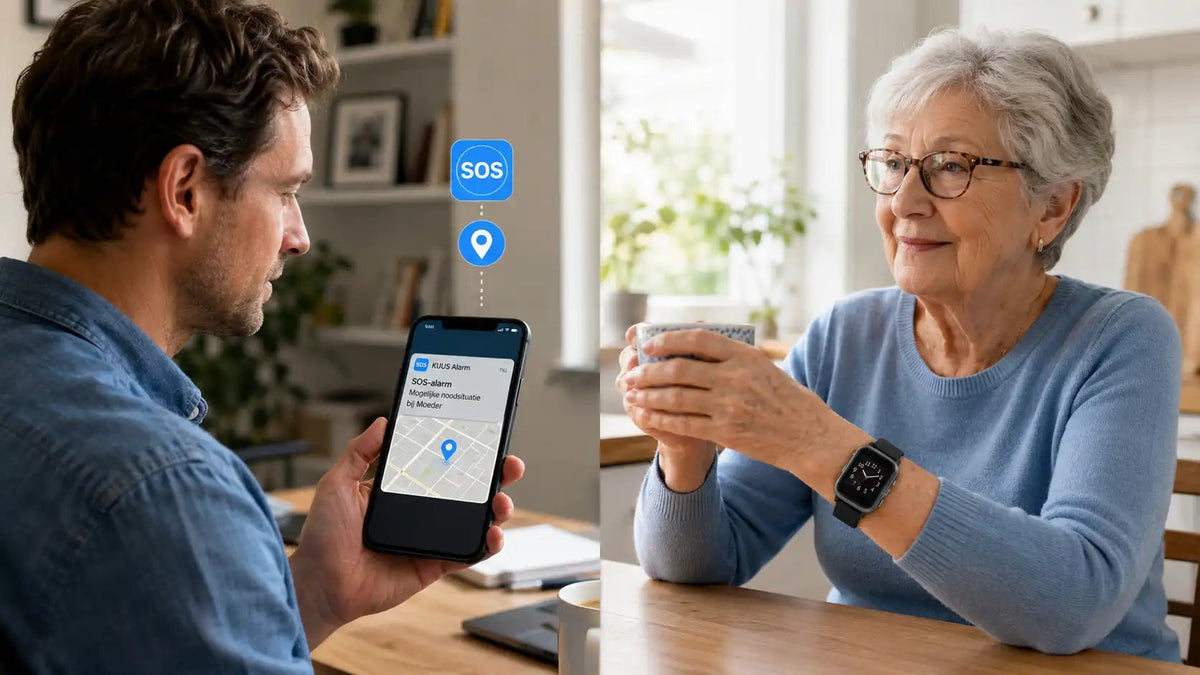
A personal alarm for elderly parents is a wrist-worn watch with "an SOS button and motion sensors that can recognise a fall." If your parent presses the button, or the watch detects a fall, it automatically calls you or another chosen contact. It has its own SIM card built in, so it works without a smartphone and also away from home, in the garden, on the street, on the way to the shops.
For caring for elderly parents from a distance, that's exactly the part you can't cover yourself. You can't be in Edinburgh within a minute. The watch can let you know something's wrong within a minute, along with the location.
And to be honest about what it doesn't do. A personal alarm doesn't prevent a fall. It isn't a medical device, it doesn't diagnose anything, it doesn't monitor an illness. It does one thing well: get help quickly when something goes wrong. With KUUS, the watch calls you, not a monitoring centre, because in a genuine emergency you want the people who care most about your parent to know first.
That's also why it works without a subscription. You buy the watch once and choose your own SIM card. No ongoing costs of €25 to €35 a month like a monitoring centre service. To your parent, it's a watch. To you, it's peace of mind.
Would you like to know which model fits? Take a look at the KUUS personal alarms for elderly parents, with an SOS button, fall detection and GPS.
How to have the conversation without being patronising
The hardest part of caring for elderly parents from a distance is often not the technology, but the conversation. Many parents hear "you need help" as "you're old and can't cope any more". Then they dig their heels in.
What helps:
- Make it about you, not about them. Not "Mum, I think you should wear an alarm", but "Mum, I lie awake when you don't answer in the evening, with this watch I know you can just call if something's wrong". That's not a diagnosis, that's a son or daughter who can sleep.
- Sell a watch as a watch. A personal alarm looks like an ordinary smartwatch. Give it as a nice gift, not as a medical device.
- Start small. One thing at a time. Fixed call times first, the watch later. Too much at once feels like a takeover.
- Give it around the holidays. At Christmas you're together longer anyway, and you often notice things you'd missed before. Giving a watch as a present is easier than raising the subject separately.
When a personal alarm isn't the right solution
You don't read this often, but it belongs here. A personal alarm doesn't suit every situation.
- When a healthy partner is always at home. Then the problem the watch solves doesn't really exist.
- With advanced dementia. Someone who keeps taking the watch off or losing it won't wear it reliably. A different solution fits better then.
- If your parent flatly refuses to wear any technology. That's a battle you lose more often than you win. Have a different conversation about safety at home instead.
- If you want 24/7 professional monitoring. KUUS calls family. For more intensive medical follow-up, a monitoring centre service suits better.
Better an honest no than a purchase you regret.
The questions we get asked most often about caring from a distance. Is your question not listed? Click on the photo of Hans at the bottom right and he will help you further.
Frequently asked questions
How do I care for my parent when I live far away?
With a combination of fixed call times, a contact person nearby, help with shopping and admin, and tools that let you know things are okay. The most important question to sort out first: how will you be warned if something happens, and how quickly can help get there?
Which tool suits caring for elderly parents from a distance?
It depends on your biggest worry. If it's a fall or sudden illness, a personal alarm for elderly parents with an SOS button and fall detection is the most targeted option, because it also works away from home and calls automatically. If it's mainly loneliness or contact, video calling helps more.
Does a personal alarm work if I live abroad?
Yes. The watch calls the chosen contacts, and that can be a foreign number. Worth arranging: also add someone near your parent to the contact list, so someone can always get there quickly.
Will I get a notification if my mother falls?
With a personal alarm that has fall detection, the watch automatically calls the first contact if it recognises a fall and the alarm isn't cancelled. You then receive the call, along with the location. Fall detection isn't a perfect technology, a false alarm happens occasionally, but a missed fall is far worse than a false alert.
Does a personal alarm need a subscription?
Not necessarily. There are models without a subscription, where you choose your own pay-as-you-go SIM card from around €5 a month. With models that include a monitoring centre service, you pay €25 to €35 a month. With KUUS, the watch calls family directly, with no ongoing costs.
Finally
Caring for elderly parents from a distance doesn't mean taking everything over. It means being organised enough that you know when something goes wrong, and that help arrives quickly. Fixed call times, someone nearby, and for the biggest worry, the fall nobody notices, a watch that calls on its own.
Our mother-in-law lay on the kitchen floor for two days before anyone noticed. We started KUUS so another family wouldn't go through that. The watch is a tool, not a goal in itself.
About the writer
Bas Lommen is co-founder of KUUS. Together with his father Eric, he started the company after a family incident in which a loved one lay on the kitchen floor for two days before help arrived.