GPS watch for elderly: the guide for families

Some images are AI generated
By: Bas | Last updated: 2 June 2026
Contents
- What is a GPS watch for elderly?
- How does the GPS location work?
- Geofencing: setting a safe zone
- A GPS watch and dementia
- GPS tracker for seniors in care and for family carers
- Without a smartphone and with no subscription
- Battery life, charging and 4G
- What should you look for when choosing?
- Simple operation in plain English
- Frequently asked questions
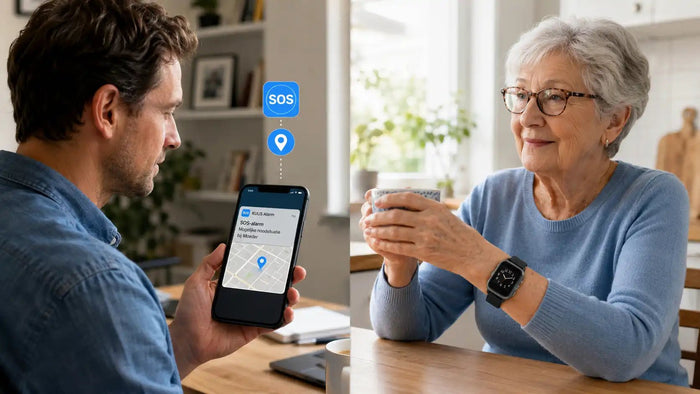
A GPS watch for elderly is a wristwatch with built-in GPS location and an SOS button. It shows family where the wearer is, and the wearer can call for help with a single press. Many models send the location automatically with an alarm, offer a safe zone (geofencing) and detect a fall. It runs on its own SIM card, so the wearer needs no smartphone. In this guide you will read what a GPS watch actually does, when it is useful (particularly with early dementia), what to look for, and how to avoid ongoing subscription costs.
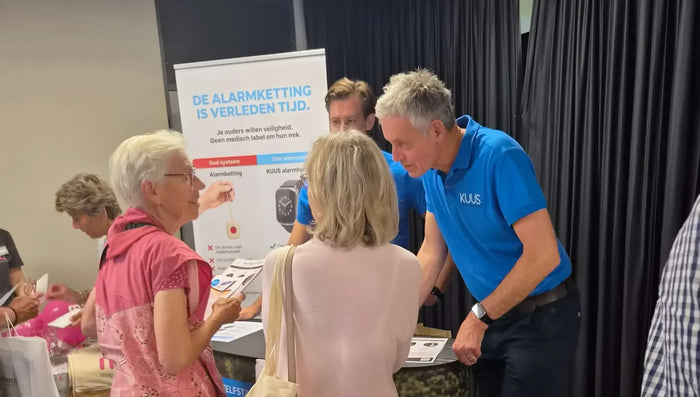
A little background. We are Eric and Bas, father and son. We started KUUS. after a fall in our own family where help arrived far too late. Ever since, everything we do comes back to one question: can someone be found and helped quickly?
What is a GPS watch for elderly?
A GPS watch for elderly looks like an ordinary watch and works like one too, but it has two extra things inside: an SOS button and GPS positioning. That lets the wearer call for help, and lets family see where he or she is. The difference from an ordinary smartwatch (Apple Watch, Samsung) is that a GPS watch for seniors works independently through its own SIM card. A personal alarm that only works when a charged smartphone is nearby is a design flaw. It should work on its own.
How does the GPS location work?
The watch works out its position via satellites, just like the navigation in a car. In town that is usually accurate to within five to ten metres; inside a building or among dense housing it is less precise. For a family member who is looking for someone, that is more than enough. When an alarm goes off, the watch sends the location automatically, and the app on your phone shows the position on a map. So you know not only that something has happened, but where as well. Indoors, where GPS works less well, many watches switch to positioning via phone masts.
Geofencing: setting a safe zone
Geofencing is a useful function: in the app you draw a safe zone around, say, the house and the street. If the wearer leaves that zone, you get an alert automatically. This is not a way of keeping tabs on someone, it is a safety net. You do not have to watch all day; you only hear about it when something falls outside the ordinary.
A GPS watch and dementia
With early dementia a GPS watch is often at its most valuable. Someone can lose their way on a walk that is normally no trouble at all. With GPS and geofencing you quickly see where they are and can act in time. There are advice services that can tell you more about moving about safely with dementia and about care and support at home. To be honest about it, though: with advanced dementia a watch no longer works reliably, because it gets taken off or lost. At that point look at a dedicated GPS tracker for dementia or another aid.
GPS tracker for seniors in care and for family carers
It is not only families who use a GPS watch. In home care and among family carers it is a practical aid too. A care worker or family carer can see in the app where the person they support is, and gets an alert if an alarm is raised, so it is immediately clear where help is needed. That saves time searching and unnecessary worry. Someone who works during the day can still keep an eye on things without ringing all day long. One thing matters here: talk openly about it with the person wearing the watch. A GPS watch should be an agreement that widens someone’s freedom, not covert monitoring.
Without a smartphone and with no subscription
Two things that often get mixed up. Without a smartphone means the watch has its own SIM card and calls and locates by itself. The wearer does not need to be able to use a phone. You, as the family member, do need a smartphone for the app. With no subscription means you are not tied to ongoing monthly costs with the manufacturer. You pick your own prepaid SIM card, from around €1 a month for data. Many people deliberately look for a GPS tracker for seniors with no subscription, and rightly so: over five to ten years that adds up to thousands of euros.
Battery life, charging and 4G
GPS uses power, so battery life matters more on a GPS watch than on a plain alarm button. Three points:
- Battery life. Two to five days is normal. The more often the watch reports its location, the faster the battery runs down. Choose a model where you can set that frequency.
- Charging. Tie charging to a fixed moment in the day. A magnetic charger is easier for stiff hands than a small plug.
- 4G rather than 2G. 4G has better coverage and will keep working in the years ahead, while providers are switching off the old 2G networks step by step. A 2G watch is no longer a good buy.
What should you look for when choosing?
- Does it work on its own? Its own SIM card, no dependence on a smartphone.
- GPS accuracy and geofencing. Can you set a safe zone?
- Fall detection. Useful if your parent cannot press the button themselves after a fall.
- Battery life. Two to five days is normal. GPS uses power, so check this.
- Waterproof. Otherwise the watch comes off at shower time and stays off.
- Will your parent wear it? A watch that looks like an ordinary watch gets worn.
- Subscription or your own SIM card? Work out the total cost over the years.
Simple operation in plain English
A GPS watch is only useful if your parent is happy to wear it and use it. Look for a large, clear screen, a physical SOS button rather than a touchscreen alone, and menus and alerts in English. A watch that is half in another language gets half used. Setting it up is best done together. Add the contacts, draw the safe zone, and then test once, for real, that the alarm and the location work. Then you know it is right before you need it.
Frequently asked questions
Which GPS watch suits your situation?
The right GPS watch is the one your parent actually wears and that works independently through its own SIM card. After that, look at GPS accuracy, geofencing, fall detection, battery life and whether a subscription is attached.
Does a GPS watch work with no subscription?
Yes. With models that have no subscription you pick your own prepaid SIM card, from around €1 a month for data. You are not tied to ongoing costs with the manufacturer.
Does a GPS watch work without a smartphone?
Yes, provided it has its own SIM card. The wearer needs no phone. You, as the family member, do use an app on your own phone to see the location.
How accurate is the GPS?
Outdoors, usually to within five to ten metres. Inside a building or among dense housing it is less accurate. For finding a family member again, that is more than enough.
Is a GPS watch suitable for someone with dementia?
With early dementia it is very useful, thanks to location and geofencing. With advanced dementia the watch is often taken off or lost, and another solution fits better.
What is geofencing?
You set a safe zone in the app. If the wearer leaves that zone, you get an alert automatically. Useful for knowing in good time that someone has gone further afield than usual.
How often do I need to charge a GPS watch?
Usually every two to five days, depending on how often the watch reports its location. Tie charging to a fixed moment, at breakfast for example, so it does not get forgotten.
Is it acceptable to track someone with dementia using a GPS watch?
For safety reasons it is, but discuss it as far as possible with the person wearing it and with the family. A GPS watch should widen someone’s freedom, not become a means of covert monitoring.
Finally
A GPS watch is not a monitoring device and not a medical device. It is a watch that shows where your parent is and that can call for help. For your parent it is simply a watch. For you it is the reassurance that you can find someone quickly.
Wondering which KUUS. model fits? Have a look at the alarm watches with GPS, all of them without a compulsory subscription.
About the author: Bas Lommen is co-founder of KUUS. Together with his father Eric he started the company after an incident in the family in which a loved one lay on the kitchen floor for two days before help arrived.